For international buyers, choosing between Yiwu market sourcing and direct factory sourcing should not be based on price alone. Factors such as product variety, order volume, customization needs, MOQs, and sourcing capabilities also matter. Yiwu market is generally better suited to multi-category sourcing and flexible MOQ, while direct factory sourcing may be more suitable for large-volume, repeat, or customized orders.
This guide compares both approaches across product selection, pricing, MOQs, customization, quality control, logistics, communication, and long-term sourcing efficiency to help you choose the right option for your business.
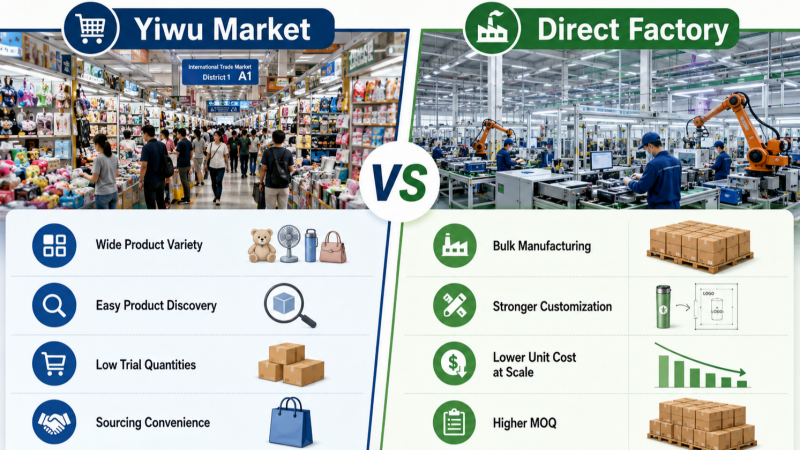
1. Yiwu Market vs Direct Factory Sourcing: Core Differences
The market and the factory serve different buying jobs. A market is built for breadth and fast comparison; a factory is built around a narrower production capability and a clearer process.
| Buying Point | Yiwu Market | Direct Factory |
| Product variety | Wide, with many styles and categories in one trip | Narrower, usually stronger in a defined product family |
| MOQ | Often workable for smaller or mixed orders, subject to seller policy | May be higher, especially for dedicated production or custom packing |
| Multi-SKU sourcing | Strong for collecting many SKUs from different contacts | Efficient only when the factory's own range covers the SKUs |
| Unit price | Can be competitive; service and trading layers need checking | Can be lower at scale, but tooling, packing and coordination add cost |
| Customization | Ready styles and light changes are easier than deep development | Better for fixed specifications, private packaging, molds and process changes |
| Ready stock | More likely for standard styles, but stock status must be confirmed | Possible for regular lines; production capacity may be prioritized for orders |
| Multi-supplier consolidation | A key advantage when cartons are coordinated through a warehouse | Usually limited unless a separate logistics plan is arranged |
The practical lesson is simple: calculate the complete order. A low factory price may be offset by a large MOQ, mold charge, separate carton, domestic transfer or unused stock. A market order may carry a higher unit price but reduce development time, allow a mixed Yiwu wholesale basket and make market testing possible.
2. When Should You Choose the Yiwu Market?
The market is usually the better starting point when variety and speed of comparison matter more than deep product development. It also suits buyers who are still testing which styles deserve a repeat order.
2.1 Many Different Products
If the purchase includes storage, kitchen goods, gifts, accessories and seasonal lines, the market can reduce travel and communication overhead. Several suppliers can be compared in one route, and products can be grouped by target price before the buyer commits to a large factory program. The limitation is consistency: each supplier may use a different material, pack standard or lead time.
2.2 Low MOQ
Small retailers, test brands and online sellers may need a few cartons per SKU rather than a full production run. Market suppliers may offer ready styles or smaller order options, but MOQ is never automatic. Confirm whether the quoted quantity is a true order minimum, a stock quantity or a price-break quantity, and ask how mixed colors or assortments are counted.
2.3 Market Testing
A market is useful when demand is uncertain. A buyer can test color, size, packaging and price response with a controlled selection, and then move the winning SKU to a factory after sales data is available. Keep the sample and specification from the test order so a later factory comparison does not become a discussion based only on photographs.
2.4 Small-Commodity Categories
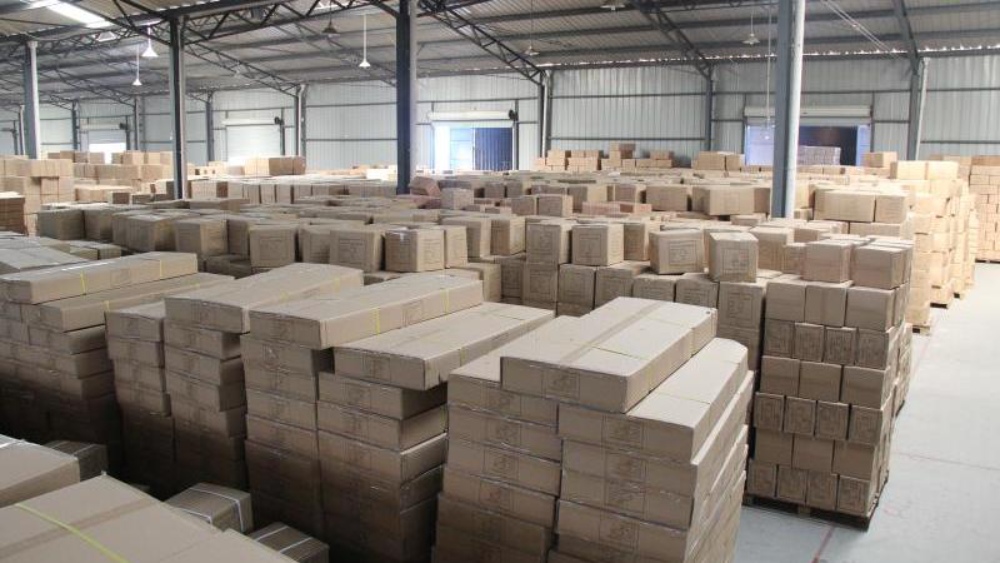
The market is particularly convenient for items with many variations and modest tooling needs, such as organizers, household accessories, gift products and simple retail goods. Buyers can compare finish and packaging in person. For regulated, technical or highly performance-sensitive products, a market visit should lead to factory and document verification before a commercial order.
2.5 Better Sourcing Efficiency
Efficiency means fewer wasted steps, not merely faster walking. A buyer can collect several comparable samples, use one specification sheet and arrange consolidation after the route is complete. The benefit falls away if each supplier requires separate payment, separate packing and separate quality follow-up. Plan the post-market workflow before treating the market as efficient.
For buyers who need fast product discovery, a structured Yiwu market sourcing route can connect ready styles with a shortlist of suppliers. The market works best when every lead is carried into a sample and cost comparison rather than left as a business card. Please feel free to contact us.
3. When Should You Source Directly From a Factory?
Direct sourcing becomes more attractive when the buyer has a stable specification, enough volume and a clear reason to work through a production process. A factory quote should still be tested against the cost of tooling, packaging, inspection, domestic transport and repeat-order management.
3.1 High Volume Of One Product
A large, repeatable order can justify direct contact with a production facility because capacity, material purchasing and line scheduling may support a better total result. The threshold varies by category. Compare the factory's minimum run, monthly output, lead time and quality controls with the actual sales forecast rather than an optimistic first-year estimate.
3.2 Specialized Manufacturing Products
Products requiring a defined process, technical material, testing method or dedicated equipment are better evaluated at the source. A factory can explain process limits, tolerances, tooling and inspection points more clearly than a general market contact. The buyer should still verify whether the named facility performs the critical process or subcontracts it.
3.3 Long-Term Repeat Orders With Fixed Specifications
A stable SKU benefits from an approved sample, written tolerances, a repeat-order calendar and a clear corrective-action process. Direct factory sourcing may make that relationship easier to build. It is not enough to agree on a product photo. Record material, size, color, packaging, carton data, permitted changes and the process for approving revisions.
3.4 Customization
Logo placement, printed packaging, color matching, special accessories and structural changes all require a more detailed conversation. A direct factory can be better equipped for production changes, but the buyer should ask for artwork proof, sample stages, setup charges, mold ownership and the cost of revisions before production starts.
3.5 New Molds
New tooling can create a defensible product difference, but it also adds design, testing, approval and ownership issues. Confirm the mold cost, expected life, maintenance, storage, ownership, exclusivity and what happens if the project is cancelled. A market supplier may help locate a factory, yet the mold agreement still belongs with the party that controls production.
When a buyer has a stable specification but lacks factory contacts, a China factory sourcing service can bridge the first market conversation and a proper production review. With a network of over 10,000 factories built over 29 years, we can help you find the right supplier. Please don't hesitate to reach out to us.
4. Misconception: Direct Factory Sourcing Is Always Cheaper
The factory price is only one line in the cost model. A direct order may involve a higher MOQ, custom packaging, mold amortization, sample charges, domestic collection, inspection, translation, payment risk and extra coordination. If the buyer cannot sell the full production run, the apparent saving becomes inventory cost.
Market sourcing has its own trade-offs. A ready product may carry a trading margin, have less room for customization or vary between batches. Yet it can lower the cost of testing demand, allow mixed SKUs and reduce the time needed to build a new supplier network. For a small launch, those benefits can outweigh a small unit-price difference.
A sound comparison uses landed cost per sellable unit: product, packaging, inspection, local transport, consolidation, freight, duties where applicable, damage allowance and expected slow stock. The route with the lower ex-factory price is not automatically the route with the lower commercial cost.

5. Recommended Approach: Yiwu Sourcing Agent + Yiwu Market + Factories
A blended route is often practical for buyers with mixed requirements. The market can identify styles and price bands; factories can develop high-volume or technical items; a sourcing agent can keep the specifications, samples and logistics record connected. This is a workflow choice, not a claim that one channel replaces the others.
Step 1: Use the market for discovery and shortlist the styles that fit the target customer. Record the real sample, MOQ, pack, carton and supplier contact.
Step 2: Move important or repeatable SKUs into factory verification. Ask who produces the item, which processes are internal, what can be customized and what inspection documents are available.
Step 3: Compare two cost versions: market-ready mixed order and direct factory order. Include the same quantity, packaging, quality level and shipping assumptions.
Step 4: Choose the route by SKU. Some items can stay as ready stock while a proven bestseller moves to a direct factory or a dedicated custom program.
This blended method is where a Yiwu sourcing agent creates practical value. Sellers Union can help coordinate the market shortlist, factory follow-up, sample approval, quality checks and consolidation so the buyer can compare options on the same commercial basis. We would be glad to answer any questions you may have.
6. How Should Different Buyers Choose?
There is no single best route for every buyer. The examples below are conditional scenarios, not promises about a fixed MOQ or price. The correct decision changes when volume, timing or customization changes.
Example A, a small online retailer: If the retailer wants 30 to 50 varied SKUs and has not tested demand, the Yiwu market may be a sensible first route. Low-risk ready styles and mixed sourcing can matter more than a factory discount that requires a large run.
Example B, a regional distributor: If the distributor already sells one standardized household item in several cities, direct factory sourcing may deserve priority. The decision should be based on forecast volume, replenishment timing, production capacity and quality consistency.
Example C, a private-label brand: If the brand needs a new color, logo, retail box or mold, factory evaluation is important. A market supplier can still help with style discovery, but the final order needs a party that accepts responsibility for the custom specification.
Example D, a seasonal importer: If the order is seasonal and the launch date is close, ready stock may reduce development risk. Confirm stock, packaging, inspection and shipping space early; a new mold or long production run may not fit the calendar.
Example E, a multi-category wholesaler: If the order combines many small products, a market-plus-consolidation route may reduce travel and coordination work. Direct factory sourcing can be added for the two or three SKUs with the strongest repeat potential.
When the decision involves too many moving parts, hiring a professional China sourcing agentis one efficient option. The value lies in keeping supplier comparisons, sample approvals, inspection records and shipment data in one chain, while the buyer retains the final commercial decision.
7. Sellers Union: Your Reliable Yiwu Sourcing Partner
The practical role of Sellers Union is to help buyers move between market discovery and verified supply. Its support can cover supplier matching, quotation comparison, negotiation, sample coordination, inspection, consolidation and export preparation. That broad scope suits a buyer who needs both variety and accountability rather than a single isolated quotation.
A useful starting brief includes the product list, target customer, price position, estimated volume, packaging needs, customization requirements and delivery window. Send that brief to the sourcing team so the next step can be matched to the actual order: market sampling, factory review or a combination of both.
Post time: Sep-04-2026